
Why Is A Cooling Tower Access Door Leaking?
A cooling tower access door should allow maintenance crews into the unit without becoming a path for water, air, and debris. When moisture appears around the opening, the first reaction is often to tighten the knobs as hard as possible. That can hide the real problem and may distort the door or damage the hardware.
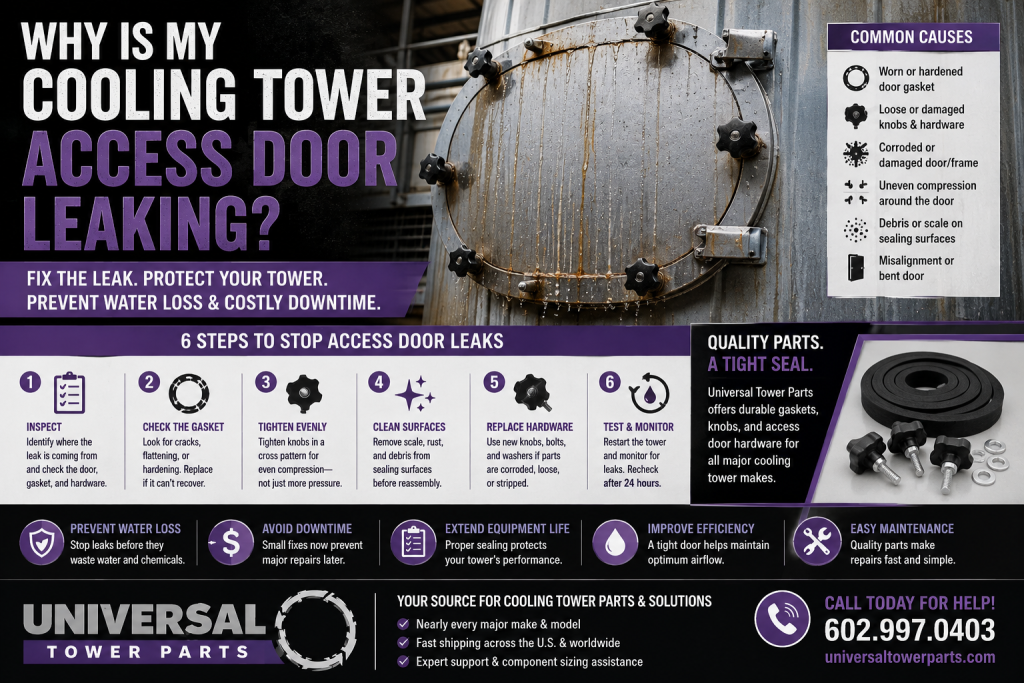
A leaking cooling tower access door usually points to a worn gasket, uneven compression, loose or corroded hardware, damaged sealing surfaces, or a door that no longer sits square in the opening. Universal Tower Parts sells neoprene gasket stock and replacement access door hardware for these applications.
Inspect The Leak Before Removing Parts
Follow the facility lockout and tagout procedure before opening or entering the tower. Note where the water appears while the unit is operating, then shut the equipment down before touching the door.
Water at the bottom of the opening may come from a flattened gasket. A wet streak from one side may indicate uneven knob pressure or a bent door. Moisture above the opening may be running down from another component, so do not assume the gasket is responsible until the surrounding area has been checked.
Photograph the door, frame, hinges, knobs, and gasket before disassembly. Mark the door orientation when it can be installed in more than one position.
Look For A Gasket That Cannot Recover
Round and rectangular access doors commonly use neoprene or another resilient gasket to fill small irregularities between the door and frame. Over time, heat, moisture, treatment chemicals, mineral deposits, and repeated compression can leave the material hard, cracked, stretched, or permanently flat.
Clean a short section and press it with a finger. A serviceable gasket should recover rather than remaining crushed. Check for open joints, missing pieces, areas pulled away from the channel, and sections coated with scale.
Adding sealant over a failed gasket rarely creates even compression. It can also leave raised areas that prevent the door from sitting correctly during the next repair.
Check Knobs, Bolts, Hinges, And The Door Frame
The gasket can only work when the hardware pulls the door evenly against the frame. Inspect knobs for stripped threads, cracked handles, missing washers, corrosion, and unequal engagement. Check hinges or retaining hardware for looseness and distortion.
Tighten knobs gradually in an alternating pattern rather than fully tightening one side first. The goal is even compression, not maximum force. When one knob reaches the end of its travel while another remains loose, the hardware or door alignment needs attention.
Inspect the sealing surface for rust scale, old adhesive, dents, weld spatter, and accumulated debris. Clean it without removing sound protective coating from the surrounding metal. Replacement knob kits and individual access door parts are available for several common tower designs.
Measure Before Ordering A Replacement Gasket
Record the tower manufacturer, model, serial number, door shape, outside dimensions, gasket diameter or cross section, and total length required. For round doors, measure the sealing path rather than assuming the nominal door size tells the whole story.
Some access doors use continuous cord stock joined during installation. Others use a formed gasket. Measure the groove and existing material before choosing a diameter. Gasket stock that is too small may not compress enough. Material that is too large may keep the door from seating correctly.
Order damaged knobs, handle kits, bolts, or washers at the same time. Replacing the gasket while retaining hardware that cannot apply even pressure may leave the original leak unchanged.
Install The New Gasket On A Clean Surface
Remove old adhesive and loose deposits using a method suitable for the door material and coating. Dry the surface before fitting the new gasket. Follow the equipment or gasket manufacturer’s instructions for adhesive, joint location, and curing time.
Avoid stretching cord stock around the opening. Stretched material may later shrink and open a gap at the joint. Close the door gently, apply even compression, and inspect the seal after the tower returns to service.
Find Cooling Tower Access Door Parts At Universal Tower Parts
Universal Tower Parts supplies neoprene access door gasket stock, access door knobs, knob kits, hardware, sealants, and replacement parts for cooling towers, fluid coolers, and evaporative condensers. Call 602 997 0403 with the tower information, door measurements, photographs, and required quantity for help matching the gasket and hardware to your unit.
Live References
Universal Tower Parts: Neoprene Door Gasket Stock
https://www.universaltowerparts.com/product/neoprene-door-gasket-stock/
Universal Tower Parts: Cooling Tower Parts Store
https://www.universaltowerparts.com/product-category/tower-parts/page/2/
Baltimore Aircoil Company: Access Door Parts
https://shop.baltimoreaircoil.com/c-41-access-door-parts.aspx
Baltimore Aircoil Company: Parts and Maintenance Guide
https://baltimoreaircoil.com/key-resources/brochures/bac-parts-maintenance-guide