
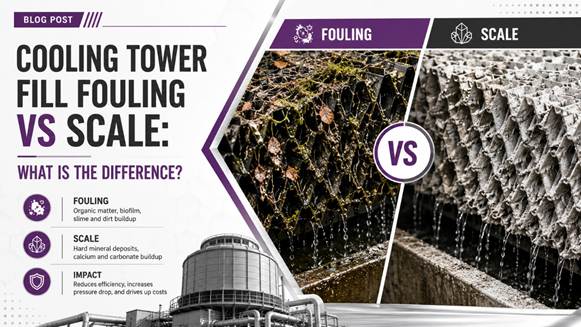
Dirty cooling tower fill is not one single condition. A deposit may be hard mineral scale, loose airborne material, corrosion products, biological matter or a mixture of contaminants. The difference matters because cleaning methods, water treatment decisions and replacement timing depend on what is actually present.
A quick look through an access opening can reveal that the fill is coated, but appearance alone does not always identify the cause. Before choosing a cleaner or ordering replacement media, the tower should be inspected and its operating history reviewed.
What Is Scale on Cooling Tower Fill?
Scale forms when dissolved minerals leave the water and create solid deposits on a surface. Calcium compounds are common examples, although the exact deposit depends on the makeup water and operating conditions.
Scale often feels hard and adheres closely to the fill. It can narrow the spaces that should remain open for air and water movement. As deposits grow, the tower may need more fan energy or longer operating time to provide the same cooling result.
Visible mineral deposit does not automatically mean that all fill must be replaced. The important questions are how much material has accumulated, whether passages are closing and whether the fill remains structurally sound.
What Does Fill Fouling Mean?
Fouling is a broader term for foreign material collecting on or within the fill. Silt, dust, iron oxides, process contamination and suspended matter may enter through makeup water, airborne exposure or another part of the system.
Fouling can be soft, sticky, loose or layered. It may trap additional particles and gradually block airflow. In severe cases, the extra weight can place stress on fill supports and the surrounding tower structure.
It should not be assumed that every dirty fill pack has the same composition. A water treatment specialist may need to examine the deposit and current water chemistry before corrective work begins.
Signs Deposits Are Affecting Performance
Restricted fill does not always cause a sudden failure. More often, tower approach worsens gradually and leaving water temperature becomes harder to control during heavy demand.
Operators may notice higher fan use, uneven water flow, dry and wet patterns across the fill, visible sagging or pieces of brittle media in the cold water basin. Airflow may also appear uneven from one section to another.
These symptoms can have more than one cause. Fan condition, water distribution and operating load should be checked alongside the fill. Replacing media will not solve a blocked nozzle, weak pump or incorrect flow rate.
Can Fouled or Scaled Fill Be Cleaned?
Some deposits can be removed, but cleaning is not automatically the safest or least expensive answer. Fill type, age, deposit thickness and chemical compatibility all matter. Older PVC may crack during handling, while an unsuitable chemical can damage the media or other tower components.
Cleaning should follow the manufacturer’s guidance and the facility’s water management procedures. Chemical treatment should be selected and supervised by qualified professionals. Pressure washing at close range can deform thin sheets or drive debris farther into the pack.
After cleaning, the fill should still be checked for brittleness, distortion and blocked passages.
When Replacement Is the Better Choice
Replacement becomes more likely when fill is collapsing, heavily restricted, physically damaged or carrying deposits that cannot be removed without harming the media. Continuing loss of thermal performance after other causes are corrected is another reason for closer evaluation.
The new fill must suit the tower and water conditions. High efficiency film fill may work well in a clean application, while a more fouling resistant design may suit repeated suspended solids. Dimensions, flute style, orientation and support requirements should be confirmed before ordering.
Find the Right Replacement Fill Media
Universal Tower Parts supplies replacement fill media and related cooling tower components for many makes and models. Accurate tower information, fill measurements and clear photographs can help the team identify a suitable replacement instead of relying on appearance alone. For help comparing cooling tower fill fouling versus scale or ordering properly matched fill media, call Universal Tower Parts at 602 997 0403.
References
https://spxcooling.com/fill-fouling-evaluation/
https://spxcooling.com/video/is-my-cooling-tower-fill-dirty/
https://www.watertechnologies.com/handbook/chapter-25-deposit-and-scale-control-cooling-system
https://www.universaltowerparts.com/what-is-cooling-tower-media/